

Our daily work with Malaysian retailers reveals a frustrating, common pattern. You invest heavily to drive high-quality traffic, only to watch eager buyers vanish right at the finish line.
Our focus at Adam SEO, established by search veteran Adam Yong in 2011, has always been on tangible business outcomes rather than just raw traffic. This specific guide is a foundational piece of our E-commerce SEO services hub.
Our strategy proves that to reduce cart abandonment seo cro adjustments must work perfectly in sync.
Let’s examine the 2025 data on why local shoppers leave empty-handed. Our team will then break down the exact checkout optimisation steps you can implement today.
Abandoned carts are revenue you already earned
A shopper who adds an item to their cart has already demonstrated incredibly high purchase intent. Our analysis shows that losing them at this final stage represents a massive, highly preventable revenue leak.
Local businesses miss out daily, especially with 2025 data from the ECDB reporting a staggering 74% e-commerce cart abandonment rate across Malaysia. We know this statistic proves that attracting visitors is only half the battle. Recovering just a small fraction of these lost sessions dramatically improves a store’s bottom line. Our experience confirms that the same disciplines powering good search visibility, like speed and clarity, are exactly what keep buyers engaged.
Where checkout breaks down
Most checkout failures stem from a few highly specific friction points. Our audits consistently reveal that shoppers simply walk away when the final steps feel confusing, slow, or surprisingly expensive.
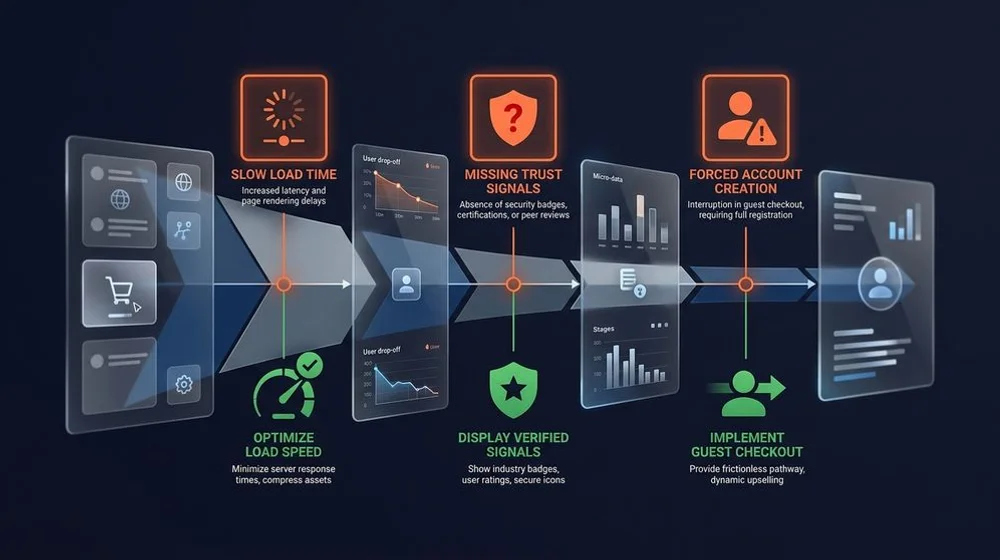
Hidden costs are frequently the biggest culprit in lost sales. We see this reflected in research indicating that 47% of users abandon their purchases due to unexpected shipping fees or taxes appearing at the last second. Another uniquely local issue is known as ‘Payment Gateway Fatigue’. Our team points to industry reports showing that a cluttered payment process with too many uncurated options causes roughly 22% of lost sales in Malaysia. A thorough review of common friction points and their impact is highly recommended.
| Checkout Friction Point | Primary Cause | Estimated Impact on Drop-Offs |
|---|---|---|
| Unexpected Costs | Surprise PosLaju or J&T shipping fees added at the end | ~47% of abandoned sessions |
| Payment Fatigue | Cluttered, uncurated checkout options | ~22% of lost sales in Malaysia |
| Mandatory Sign-Ups | Forcing account creation before purchase | ~25% of frustrated buyers |
| Weak Trust Signals | Missing secure badges or clear policies | Instant loss of buyer trust |
Our strategy focuses on removing these exact obstacles to recover sales without spending a single ringgit more on traffic.
Speed and Core Web Vitals
Page speed acts as the exact point where search visibility and conversion optimisation meet. Our technical team sees slow load times actively hurt your rankings while simultaneously driving impatient shoppers away mid-checkout. A single fraction of a second completely alters buyer behaviour.
“A recent Deloitte benchmark study found that improving a retail site’s speed by just 0.1 seconds increases conversion rates by 8.4%.”
We constantly tune performance to align directly with Google’s latest standards to capture this revenue. Optimising your site means focusing heavily on Interaction to Next Paint (INP), a crucial 2025 metric measuring how fast a page responds to a button click. Our Core Web Vitals explained resource provides the exact technical requirements you need to track. Faster pages consistently rank better and keep more carts active.
Trust signals at the moment of decision
Our most successful campaigns prove that visible reassurance at the final payment stage is absolutely critical. Buyers need to see clear security badges, transparent return policies, and familiar local banking options before handing over their cash. We strongly advise adding these specific trust markers directly to your checkout page:
- Recognisable local wallets: Display Touch ‘n Go and GrabPay logos early.
- Direct FPX banking: Show that major Malaysian banks are supported.
- Clear security icons: Use SSL padlock icons near the credit card fields.
- Upfront return rules: Place a one-sentence return policy directly under the ‘Buy’ button.
Honest, upfront pricing serves as the final piece of this trust puzzle. Our conversion specialists know that implementing these simple signals costs very little, but they immediately lift your total completed orders.
Smoother UX, fewer drop-offs
A clean, short, and guest-friendly checkout consistently creates the highest conversion rates. Our main goal is always to make completing a purchase the absolute path of least resistance. Reducing the number of form fields to the bare minimum respects the user’s time. We use progress bars to show clearly defined steps, helping eliminate any confusion about how long the process takes.
The mobile-first advantage
The vast majority of Malaysian online shopping happens on mobile screens. Our designers pay special attention to smartphone users, knowing that forcing them to pinch, zoom, or type out long addresses manually is a guaranteed way to lose a sale. Address autofill features and large, high-contrast buttons keep momentum moving forward. We build strong product pages specifically to set this up, sending confident, ready buyers straight into a frictionless final step.
Retargeting closes the gap
Even with a perfectly tuned website, some shoppers will inevitably step away. Our marketing data shows that retargeting campaigns and abandoned-cart flows serve as the crucial safety net to bring those high-intent users back. A polite, perfectly timed WhatsApp reminder sent an hour after abandonment often cuts through the digital noise effectively. We see fantastic recovery rates in Malaysia when brands use WhatsApp or SMS instead of just traditional email. A structured recovery campaign typically relies on three specific touchpoints:
- The immediate reminder: A gentle nudge sent within the first hour.
- The specific incentive: A small shipping discount offered 24 hours later.
- The final check-in: A low-pressure message asking if they experienced any technical issues.
Our team combines these direct messages with a faster, optimised site experience. This two-pronged approach recovers a highly meaningful share of your missed sales.
Recover the sales you are losing
Our conclusion is clear: fixing your checkout flow is one of the most profitable improvements an online store can make. You already invested in acquiring the visitor, so proper cart abandonment cro efforts ensure those marketing budgets deliver a return.
We understand that locating the exact technical bottlenecks requires a specialised, experienced eye. To pinpoint your biggest leaks, Adam SEO provides a comprehensive discovery audit with zero obligation. Our targeted approach to reduce cart abandonment seo cro methods will highlight the exact changes you need. Reach out today to turn those hesitant shoppers into completed orders.