
Two channels, two jobs
We regularly see Malaysian businesses treat the seo vs google ads debate like a bitter rivalry.
This mindset is a quick way to burn through your marketing budget.
Google currently controls roughly 92% of the local search market in 2026, meaning your customers are definitely searching there.
Our team knows these two channels just capture that demand in fundamentally different ways.
The real question is which channel fits your goal, your timeline, and your budget.
We are going to look at the hard data, break down the costs, and show you exactly how to allocate your spend.
Cost structure: rented versus owned
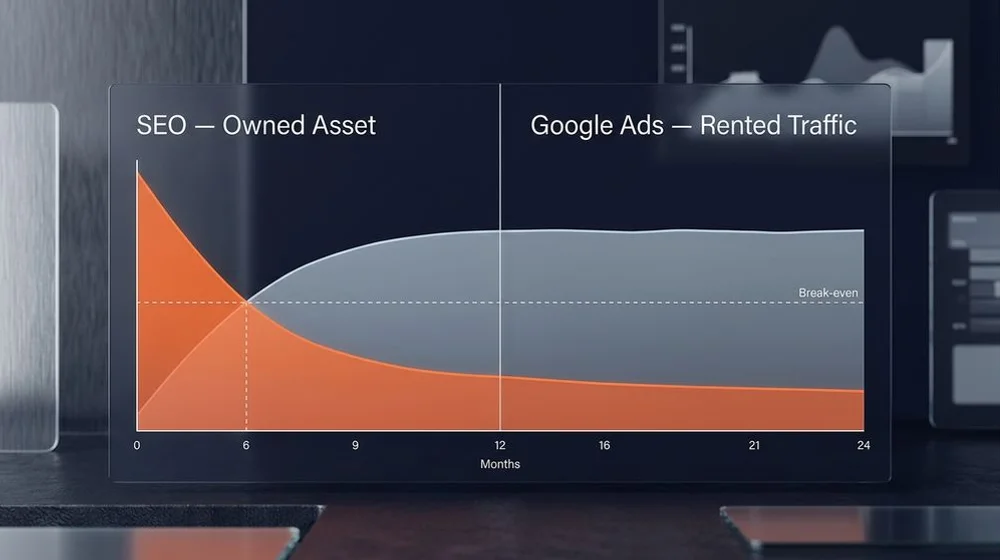
With Google Ads, you pay for every single click. The traffic is instant, but it stops the moment your daily budget runs dry.
We monitor local ad costs closely to guide our clients. In 2026, standard search campaign clicks in Malaysia average between RM 1.20 and RM 5.50.
Competitive markets like finance or legal services often see costs spike much higher. This makes relying solely on paid traffic an expensive long-term strategy.
With SEO, you invest in building rankings that become a permanent, owned asset. The upfront effort is higher and slower to pay off.
Our experience shows that once you rank on the first page, the traffic keeps coming without paying per click. Your cost per lead actually falls over time.
This compounding return is the core of how SEO increases revenue.
Key Cost Differences
- Google Ads Funding: Requires continuous, active spend to maintain visibility.
- SEO Investment: Requires upfront labour and content creation costs.
- Click Costs: Ads fluctuate based on competitor bidding, while organic clicks are free.
- Asset Ownership: You own your SEO rankings, but you only rent your ad space.
Speed: who wins the short game
Google Ads wins on speed, full stop. You can launch a campaign today and have qualified traffic this afternoon.
We use paid ads heavily for immediate validation. SEO simply cannot match that same-day turnaround.
Organic rankings typically require three to six months to show meaningful traffic growth. Google needs time to crawl, validate, and rank your new pages.
Our advice is straightforward if you are deciding on seo or google ads malaysia right now. Ads are exactly the right tool to use for immediate results.
They put your product directly in front of buyers at the exact moment they search.
Ideal Scenarios for Google Ads
- Generating sales this specific week.
- Validating a brand new product or service offer.
- Capitalizing on highly seasonal trends.
- Pushing a short-term promotion or event.
Durability: who wins the long game
SEO wins on durability every single time. An organic ranking does not disappear when you pause your marketing spending.
It is an asset that compounds, growing more valuable as your website authority builds.
We often see the top organic result capturing roughly 27.6% of all clicks for a search query. Users inherently prefer organic results over sponsored placements.
Ads reset to zero the instant you stop paying Google. You have no residual value left over after the campaign ends.
Our clients who invest in organic search enjoy a steady stream of leads long after the initial work is done. This creates a sustainable advantage that competitors cannot buy overnight.
Why Organic Results Last
- Compounding Value: Previous content continues to attract visitors for years.
- Higher Click Share: Users frequently skip past ads to click standard links.
- Immunity to Budgets: Traffic flows even when marketing funds are tight.
ROI: it depends on the horizon
When comparing seo vs ppc roi, the return on investment for both channels looks very different depending on your timeframe.
We track these performance metrics across dozens of local industries. Recent 2026 data shows that SEO conversion rates average around 2.4%, which is nearly double the 1.3% average for standard PPC traffic.
This difference comes down to user intent and brand trust.
ROI Comparison by Timeframe
| Marketing Channel | Typical Timeframe | Average Conversion Rate | Long-Term ROI Potential |
|---|---|---|---|
| Google Ads (PPC) | Immediate (Days to Weeks) | 1.3% | Moderate (Stops when spend stops) |
| Organic SEO | Long-Term (Months to Years) | 2.4% | High (Averages up to 748%) |
Short-term campaigns favour ads because they capture high-intent users ready to buy right now. They often deliver a better immediate ROI for brand new websites.
Our data shows SEO usually wins the long game. The cost per lead drops steadily over time, while ad costs consistently rise due to inflation and competitor bidding.
For most Malaysian businesses thinking past the next quarter, SEO delivers the much stronger return. It just needs the strategic runway to get there.
The hybrid that usually wins
The smartest approach for most businesses is rarely an either-or decision.
We recommend running ads for speed to capture demand right now, while building SEO for durability so your future cost per lead falls.
A highly profitable strategy involves splitting your focus across both channels.
The Ideal Budget Allocation
- 25% to Paid Ads: Use this for targeted, immediate customer acquisition.
- 75% to Organic Growth: Build long-term assets that lower your overall cost per lead.
Our search teams use your live ad data to see exactly which keywords convert best. This real-world conversion data makes your ongoing SEO investment much sharper.
You stop guessing what your customers want and start optimizing for proven, money-making search terms.
To accurately weigh this combined budget, see our detailed guide on SEO services cost in Malaysia.
Make the call with real numbers
The right mix for seo vs google ads always depends on your profit margins, your timeline, and your specific local competitors.
Since 2011, Adam SEO has built strategies around the premise that rankings are meaningless without tangible business revenue.
We can accurately model both channels for your unique business in a free discovery audit.
This analysis ensures you invest exactly where the ROI is strongest for your specific industry.
There is absolutely no obligation to commit.
Reach out to our team today, and let us build a data-driven search strategy that actually grows your bottom line.