
This guide is part of our Local SEO services hub, where we cover everything that drives local search visibility in Malaysia.
You already know that appearing at the top of Google is vital for brick-and-mortar stores and local services.
The real challenge is understanding exactly what is local SEO and how to consistently beat competitors in the immediate vicinity.
We see many Malaysian SMEs pour money into generic digital marketing while neglecting the map pack right in their backyard. Local businesses cannot afford to ignore this trend. Let us break down exactly how location-based search works here and provide clear steps to dominate your local market.
Local SEO, defined
Local SEO is the practice of getting your business found by customers searching nearby.
When someone in Kuala Lumpur searches for a service “near me” or with a location, Google shows local results, and local SEO is how you appear in them. We differentiate this from broad organic SEO because Google ranks local results using completely different signals. Recent 2026 data from BrightLocal reveals that 51% of all Google searches now carry local intent.
This means more than half of your potential customers are actively looking for businesses in their immediate vicinity. Our experience shows that businesses must optimize for three specific local elements to stay visible:
- Proximity to the searcher: How close your business physically is to the mobile user.
- Relevance of the query: How well your profile categories match the exact search terms.
- Prominence of your brand: How much trust Google has in your business data and reviews.
On top of that, Google’s introduction of AI Overviews in Malaysia throughout 2025 and 2026 has fundamentally changed discovery. AI tools now summarize the best local options before users even scroll down to traditional links.
Map Pack versus organic results
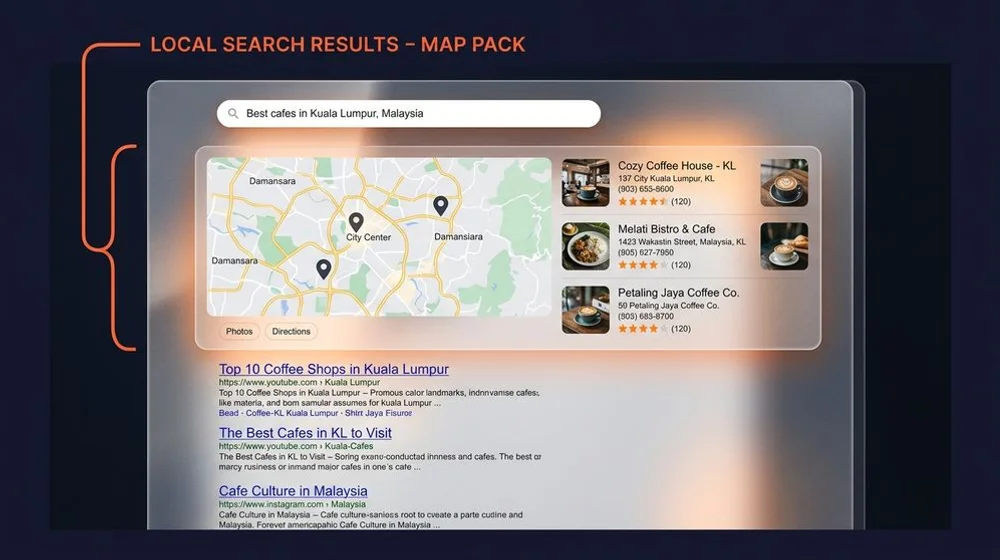
A local search usually returns two things: the Map Pack and the standard organic results.
The Map Pack features three top local businesses with reviews, a map, and a quick contact button, sitting directly above the familiar blue organic links. We prioritize getting you into that specific pack, followed by ranking your website in the organic links beneath it. That visual block is prime real estate because most local searchers act on those top three pins before ever scrolling down.
Recent 2026 industry data from Mohr Marketing highlights the massive difference in visibility between these two areas:
| Search Position | Average Click-Through Rate (CTR) |
|---|---|
| Map Pack (Top 3) | Captures 48.1% of all local clicks |
| Organic Position 1 | Averages around 19.8% to 39.8% |
| Organic Position 4+ | Plummets below 7.2% |
Interestingly, an April 2026 Sterling Sky report showed that Google is displaying fewer unique businesses in standard packs due to new AI Local Packs. This shrinking space makes it even more critical to have comprehensive local data to survive the visibility cuts. Our strategy ensures your business remains highly competitive even as Google changes its layout.
The role of Google Business Profile
The Map Pack is completely powered by your Google Business Profile.
It is the single most important asset in local SEO, holding your categories, hours, photos, reviews, and contact details. We have seen exactly how a fully complete, well-managed profile sends Google the exact relevance and prominence signals it needs to rank you. Digital Applied’s 2026 research indicates that user actions, such as calls and direction requests from these profiles, surged 41% year-over-year.
- Category Accuracy: Ensures you match high-intent searches accurately.
- Review Velocity: Signals trust and current activity to the algorithm.
- Consistent NAP: Validates your exact business name, address, and phone number across the web.
Birdeye’s 2026 state of GBP report shows that category and “near me” searches now drive 86% of profile visibility. If your profile is incomplete, you are essentially invisible to those high-intent searches. Verification is now the absolute baseline, with over 76% of all active enterprise profiles completely verified.
We cover the specific technical steps for this in depth in how to optimise your Google Business Profile. Do not treat it as a set-and-forget directory listing. Treat it as a dynamic, second homepage that requires weekly updates and immediate review responses.
How local search intent differs
Local searchers are almost always extremely close to making a purchasing decision.
Someone searching for a “plumber near me” or the “best cafe in Mont Kiara” wants to act soon, often the very same day. We focus heavily on capturing this traffic because local SEO delivers such incredibly strong return on investment. You are reaching people at the exact moment they pull out their phones ready to call or visit.
Digital Applied’s 2026 data confirms this urgency, noting that 76% of people who search for something nearby visit a business within 24 hours. This conversion rate completely dwarfs standard informational searches. The numbers become even more compelling when you look at actual sales actions:
- High Conversion: 28% of all local searches result in a direct purchase.
- Offline Action: 80% of smartphone searches for local businesses lead to an offline purchase.
- Review Reliance: 87% of consumers now read online reviews for local businesses before deciding.
Our team uses this data to prioritize high-intent keywords over generic terms that rarely convert. Winning these specific searches means capturing revenue before your competitors even get a chance to bid.
Local search behaviour in Malaysia
Malaysian buyers lean heavily on mobile search and Google Maps, and they trust user reviews and physical proximity.
Bilingual queries and area-specific searches across KL and the Klang Valley are extremely common. We always ensure effective local SEO accounts for these specific behaviors rather than applying generic global advice. Recent 2026 data shows that over 80% of Malaysian consumers access the internet primarily via mobile devices.
This means your local presence must be perfectly optimized for small screens. Beyond mobile usage, our region has a truly unique bilingual search environment. Customers frequently switch languages based on their immediate context:
- English: Often used for B2B services, technical queries, and professional consultations.
- Bahasa Malaysia: Dominates searches for local food, daily necessities, and community services.
- Chinese: Frequently used for specific trading, wholesale, and cultural goods.
An April 2026 SEO report highlighted that businesses running a purely English strategy consistently leave a substantial share of local search volume uncaptured. Our content teams build multilingual keyword maps to capture traffic across all these demographics. While Waze remains incredibly popular for daily commuting and traffic alerts in Malaysia, Google Maps completely dominates initial business discovery.
Where to go next
The next step is applying these concepts directly to your own online assets to secure a top position.
To see how the rankings actually move, read our detailed guide on ranking in the Google Map Pack in Kuala Lumpur.
We offer a free discovery audit with no obligation if you would like a professional review of your local presence. Local SEO is not an overnight fix, but it is the most reliable way to drive foot traffic in 2026.
Adam SEO will pinpoint exactly where your current strategy is leaking leads to competitors. Book your session today and let us turn your local search visibility into measurable business growth. Our goal is to build an online presence that translates into tangible foot traffic and sales.