

You already know that ranking high means nothing if visitors bounce without buying. The disconnect between traffic and sales is a common frustration for store owners.
Our team addresses this exact gap within our E-commerce SEO services hub. The foundational concepts sit in our guide on what e-commerce SEO is.
Today, the goal is turning those visits into actual revenue by applying proven product page seo best practices.
We will break down the essential components of high-converting pages. The data reveals exactly why specific page structures perform better.
These are the pages that make money
Product and category pages are where buyers decide. Malaysian e-commerce growth is surging at an impressive 17.5% annual rate going into 2026. Optimising them well is the most direct way to grow store revenue from search. They capture transactional intent at the exact moment of purchase.
Recent data from Taylor Scher SEO shows that well-optimised product pages can achieve a 2.8% organic conversion rate. Hitting that benchmark requires a precise mix of technical and content elements. Here is what a well-optimised page looks like in practice.
The anatomy of an optimised product page
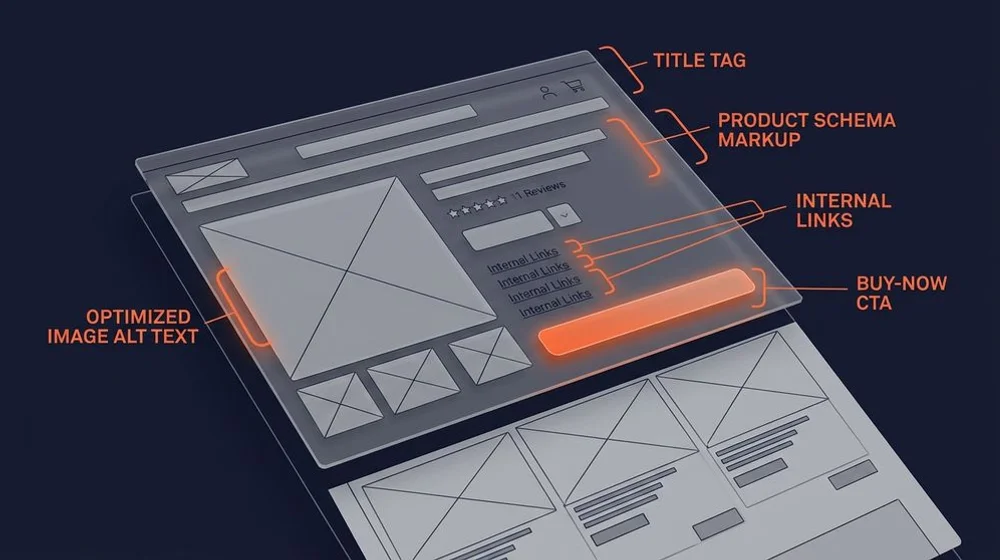
We implement a specific structure to ensure every product listing performs at its peak. Proper ecommerce on-page SEO provides the clear signals search engines need to rank your items above competitors. The checklist below covers the non-negotiable elements.
- Title and meta description. Write unique, keyword-relevant titles and compelling descriptions for every product. Avoid templated, near-identical tags across the catalogue.
- Unique product descriptions. Replace copied manufacturer text with helpful, original descriptions that answer buyer questions. Include natural keywords to match user search intent.
- Product schema. Mark up price, availability and ratings so your listings are eligible for rich results. Tools like Rank Math or Yoast make adding this structured data straightforward.
- Optimised images with alt text. Compress images into modern formats like WebP for faster loading on mobile networks. Write descriptive alt text that helps both accessibility and image search.
- Internal links. Link to related products and the parent category to spread ranking strength. This practice aids discovery and keeps shoppers on your site longer.
Category pages do heavy lifting
Category pages capture broader purchase intent and funnel shoppers to products. A 2026 Digital Applied benchmark report highlights that 38% of visitors who land on a category page successfully move on to a specific product. Optimise them with a clear, keyword-relevant title and a logical product layout.
Our strategy involves adding a concise block of helpful content that gives search engines context. Do not bury the products under long text. Balance useful content with a shopper-friendly experience.
Understanding Page Intent
Shoppers behave differently depending on where they land in your store. The table below outlines the distinct roles of these two critical page types.
| Feature | Category Page | Product Page |
|---|---|---|
| User Intent | Browsing and comparing options | Ready to evaluate a specific item |
| Search Queries | Broad terms (e.g., “running shoes”) | Specific terms (e.g., “Nike Pegasus 40”) |
| Key Metric | Click-through to individual products | Add-to-cart conversion rate |
| Content Focus | Helpful category FAQs and filters | Detailed specs, reviews, and pricing |
This structure ensures you target the right keywords on the right URLs. Effective category page SEO requires helping the user filter options efficiently without losing technical quality.
Avoid the duplicate-content trap
Variants, filters and copied descriptions create duplicate content that splits your ranking strength. A 2025 study by Reboot Online found that 53% of e-commerce websites have pages missing canonical tags. This technical oversight confuses search engines and wastes valuable crawl budget.
Our audits frequently uncover nearly identical URLs generated by basic faceted navigation. Use canonical tags and unique descriptions so search engines focus on the right pages. Platform configuration matters heavily here, see Shopify and WooCommerce SEO.
Managing Filter Pages
Filters are great for users but often terrible for search visibility. E-commerce platforms like Shopify automatically generate new URLs for every colour and size variant. This creates a massive duplicate-content surface area.
You must set sensible faceted-navigation rules to prevent indexing every single filter combination. Implementing proper canonical tags points Google to the master version of the product. The goal is to keep your index clean and your ranking signals concentrated.
Optimise for conversion, not just ranking
A ranking product page that does not convert wastes the traffic. Shoppers need absolute confidence before they hand over their money. Pair SEO with clear pricing, strong images, and easy add-to-cart functionality.
We strongly recommend integrating locally trusted payment methods to reduce cart abandonment. Over 70% of Malaysians now use e-wallets like Touch ‘n Go or GrabPay for digital purchases. On top of that, FPX bank transfers handle roughly 39% of all account-to-account e-commerce payments in the country.
Building Immediate Trust
The same page should rank well and sell well. That is the standard applied to every successful e-commerce store. Displaying verified reviews directly under the product title increases conversions significantly.
A fast, secure checkout process seals the deal. Visitors who see familiar logos like FPX or local bank icons feel safer completing the transaction. Every element on the page must guide the user to that final purchase decision.
Turn pages into revenue
Most stores have dozens of product and category pages quietly underperforming. Identifying these weak spots is the first step in achieving profitable growth.
Founded in 2011 by SEO veteran Adam Yong, Adam SEO was built on the premise that search engine rankings alone are meaningless without tangible business results.
We know that fixing these issues requires a clear, prioritised roadmap. To find the pages with the most upside, Adam SEO offers a free discovery audit with no obligation.
Reach out today to start turning your organic traffic into measurable revenue.