

We know that choosing between ecommerce seo vs google shopping ads is a daily challenge for Malaysian retailers trying to balance instant visibility and long-term profitability.
The E-commerce SEO services hub provides this guide to help you decide exactly where to allocate your marketing spend. A 2026 Shopify Global Commerce Report revealed that acquisition costs have surged across all categories globally.
Many regional store owners watch their margins shrink as ad platforms demand more budget to capture the exact same traffic. Our team will compare the real costs, durability, and conversion potential of both acquisition channels.
Let us break down the exact strategies to build a highly profitable blended acquisition model for your store.
Two ways to win the same buyer
When comparing ecommerce seo vs google shopping ads, both channels put your products directly in front of shoppers who are ready to buy. The fundamental difference lies in how you pay for that placement, and how those costs scale over time.
We see Malaysian SMEs frequently overspending on ads because they treat these two channels as separate silos rather than a unified strategy. Urban internet penetration in areas like the Klang Valley and Penang now exceeds 85 percent, meaning the digital market is highly saturated.
Store owners must make strict revenue decisions rather than basic marketing choices to protect their margins. Our founder Adam Yong built this agency in 2011 on the premise that search rankings are meaningless without tangible business revenue, and this philosophy guides how you should evaluate your acquisition channels today.
Customer-acquisition cost
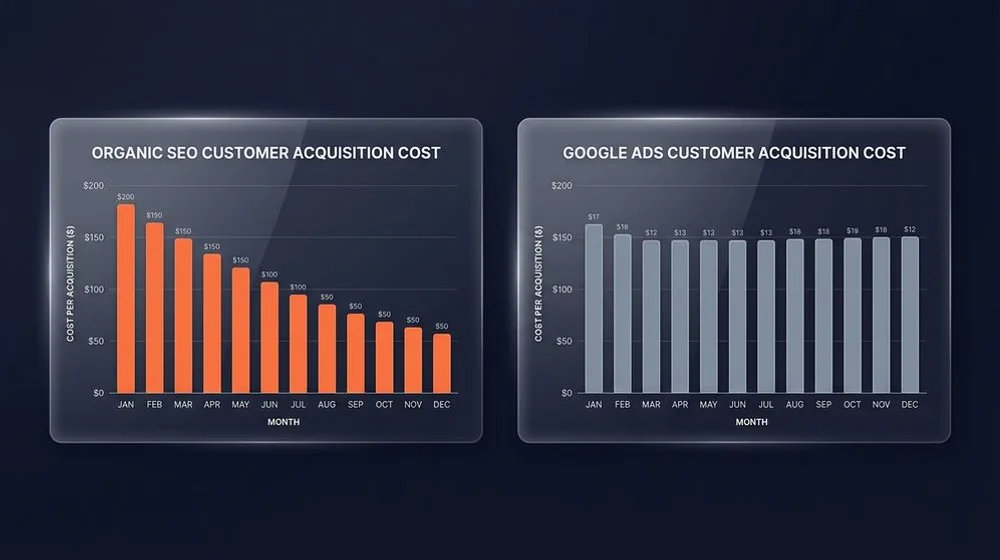
The financial difference in ecommerce paid vs organic acquisition boils down to how you are charged. Shopping Ads bill your account for every single click, while organic rankings require an upfront investment for free long-term traffic.
To clarify these structural differences, review the cost breakdown below:
| Financial Metric | Google Shopping Ads | E-Commerce Organic Search |
|---|---|---|
| Payment Structure | Pay per click (RM 1.50 to RM 6.00 average) | Upfront agency or internal resource investment |
| Traffic Longevity | Stops immediately when budget pauses | Persists long after the initial work is done |
| Acquisition Trend | Costs increase alongside market competition | Cost per acquisition decreases over time |
This CPC cost is immediate and highly controllable, but that ongoing expense tends to climb rapidly as regional competition increases. We track local ad metrics closely, and a Q1 2026 analysis from ZenWeb shows that e-commerce Cost Per Click (CPC) in Malaysia averages between RM 1.50 and RM 6.00. Customer acquisition cost for first-time buyers in the country actually climbed 23 percent last year.
The organic traffic keeps flowing without a per-click fee once you establish your search positions. We always remind clients that your cost per sale drops significantly over a longer horizon.
Organic acquisition usually becomes much cheaper after the first six to twelve months of consistent effort. This long-term cost reduction forms the core of how e-commerce SEO pays back.
Durability
Shopping Ads vanish from the search results the exact moment your budget runs out. You are essentially renting space from Google.
We focus on building organic rankings because they persist as an owned asset that generates sales without continuous click fees. A well-optimised product page can hold its position for years if maintained properly.
Many Shopify merchants misdiagnose their profitability issues by only looking at the initial click cost. The real cash trap occurs when you combine high ad costs with a 70 percent cart abandonment rate and no organic backup plan.
“The most dangerous scenario isn’t a high initial click cost, but rather a high acquisition cost paired with zero organic retention.”
We consider organic durability a major advantage for stores trying to build long-term enterprise value. You stop paying a toll for every single visitor.
Speed and control
Paid campaigns absolutely win on speed and granular control. You can launch a targeted Performance Max campaign today to push excess inventory. We often use ads to scale spend up or down instantly based on warehouse stock levels, allowing store owners to test new product images or pricing structures within hours and see immediate data.
Organic search cannot match that level of immediacy, as building a strong backlink profile and content authority typically takes months. We deploy paid campaigns to fill the visibility gap when launching a brand new product line.
Here is exactly when you should rely on paid campaigns for rapid control:
- Flash Sales: Instantly promote weekend discounts or festive season offers to a broad audience.
- Creative Testing: Quickly determine which product images drive the highest click-through rates.
- Inventory Clearing: Push specific ad spend toward overstocked items to free up warehouse space.
- New Product Launches: Guarantee page-one visibility on day one for completely new inventory.
Margin considerations
Product margins dictate your entire digital acquisition strategy when evaluating seo vs shopping ads. The per-click fee of a shopping ad can wipe out your profit immediately if you sell low-margin retail goods.
We highly recommend prioritising organic visibility for these fast-moving, competitive items. Your organic traffic protects the slim profits associated with basic consumer goods.
Paid campaigns remain highly profitable for high-margin categories like consumer electronics or specialised equipment, even at a higher cost per click. A single conversion covers the expense of dozens of clicks in these lucrative sectors.
| Product Category | Recommended Primary Channel | Why This Strategy Works |
|---|---|---|
| Low-Margin Retail | Organic Search | Free clicks preserve thin profit margins per unit. |
| High-Margin Electronics | Shopping Ads | High profit per sale easily absorbs the initial click cost. |
| New Fast-Moving Goods | Blended Approach | Ads drive initial momentum while organic rankings mature. |
Our analysts model this exact calculation per store to find the safest balance for your bottom line. The right mix depends entirely on your specific unit economics and lifetime customer value.
When to combine them
The most successful online stores in Malaysia use a blended approach to dominate their market. Run Shopping Ads to secure immediate sales and gather precise conversion data.
We use this paid data to see exactly which search terms actually generate revenue. You can then apply those proven, high-converting keywords directly to your organic strategy. Build your organic presence simultaneously to capture durable, lower-cost traffic that compounds over time.
Combining these channels provides three distinct advantages:
- Keyword Intelligence: Ad data reveals the exact phrasing buyers use, eliminating guesswork for your organic content.
- SERP Dominance: Appearing in both the sponsored and organic slots increases overall brand trust and click-through rates.
- Cost Efficiency: Profitable organic traffic subsidises the rising costs of your paid acquisition campaigns.
We suggest reviewing the typical e-commerce SEO cost to understand the budgeting required for the organic side. Balancing both channels protects your store from sudden algorithm updates and rising platform fees.
Find your most profitable mix
The smartest channel split between ecommerce seo vs google shopping ads relies on your exact profit margins, local competition, and long-term growth targets.
Our team can model both paid and organic projections for your specific store in a free discovery audit. You can then invest your marketing budget where the return on investment is strongest.
Reach out to Adam SEO to establish a data-driven strategy with absolutely no obligation.