
This guide is part of our AI Search Optimization services hub. For the foundations, see what AEO and GEO are.
We know the digital search market in Malaysia is shifting rapidly under our feet. You have probably noticed a sudden drop in traditional organic clicks across your marketing dashboards this year. This guide tackles the growing debate of AEO vs traditional SEO directly.
Our data shows that answering AI engines is now just as critical as ranking on Google. Many businesses are pouring budgets into outdated strategies. We are going to break down the specific differences and show you how to adapt.
Let’s explore what the latest 2026 data actually tells us about search behavior.
The smartest move is preparing your brand for both visibility methods.
Two approaches, one evolving goal: AEO vs traditional SEO
When evaluating answer engine optimization vs SEO, they are not opponents. They represent two stages of the same digital evolution. Our strategy at Adam SEO has always focused on tangible business growth rather than just chasing meaningless rankings. This founding principle from 2011 applies perfectly to the current shift. Traditional SEO earns rankings in the familiar list of blue links, while AEO earns inclusion and direct citation inside AI-generated answers.
Recent data paints a clear picture of this transition. Over 60% of Google searches now end without a single click to any website, according to a 2026 report tracking top digital agencies in Malaysia. This metric should wake up any brand relying entirely on old traffic models. We see local consumers increasingly demanding instant solutions.
ChatGPT usage in Malaysia alone spiked by an incredible 330% over the last year. That surge means real people are bypassing search engines to ask AI tools for local business recommendations. Our team tracks these numbers closely to keep clients ahead of the curve. You must adapt to where the attention is going.
Here is a breakdown of how the two approaches differ in practice:
| Feature | Traditional SEO | Answer Engine Optimization (AEO) |
|---|---|---|
| Primary Goal | Drive user clicks to a website | Provide instant, zero-click answers |
| Search Query Focus | Short, keyword-centric phrases | Conversational, natural language questions |
| Success Metric | Ranking position on the first page | Being named or cited as the source |
As search shifts to AI answers, the second column matters significantly more. The first approach is far from dead.
Clicks versus citations
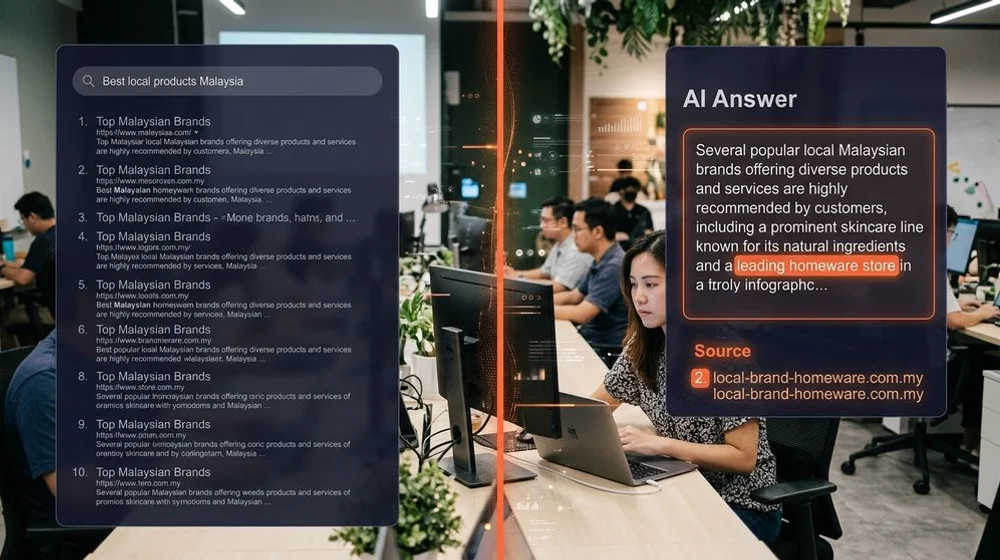
The core difference between these two strategies is what success actually looks like. Traditional SEO wins clicks to your website, while AEO wins brand citations directly inside AI-generated answers.
Our clients often ask us how to measure ROI when traffic numbers drop. Understanding this shift in user behavior reveals the solution.
Here is what winning looks like in each system:
- Traditional SEO: You rank well, the user clicks your link, and they land on your site to read your content.
- AEO: The AI answers the question directly and names or links your brand as the trusted source.
Sometimes this citation happens without a user clicking a link at all. We have reviewed the latest Search Console data from early 2026, and the impact is undeniable. Google AI Overviews now reduce organic click-through rates by up to 58% on informational queries.
That massive drop scares many marketers. Visitors who do click through from AI Overview citations, however, convert at 23 times the rate of standard search visitors.
This high conversion rate happens because the AI has already qualified the user’s intent. Our approach is to focus on that incredible conversion potential. You need to be the brand the AI builds its answer upon. When more searches resolve as zero-click AI answers, simply ranking a page is no longer enough.
Ranking versus being cited
In traditional optimization, your position on the page is everything. In AEO, being referenced by the machine as the primary source is everything.
We often see great content fail because it lacks the right technical framing. You can rank tenth in regular results and still be cited as the primary source if your content provides the clearest direct answer. Conversely, a brand can rank first organically yet be completely ignored by the AI.
The AI Measurement Gap
This exclusion happens frequently when content is not structured properly for language models to extract. The two systems reward overlapping but not identical elements.
Our analysis of the Malaysian market shows a huge measurement gap. According to a May 2026 industry survey, only 16% of brands systematically track their visibility in AI-powered search results. Most companies are completely blind to their presence on platforms like ChatGPT or Perplexity.
We help businesses close this measurement blind spot by writing for the machine first. Here are the most common pitfalls to avoid when trying to get cited:
- Burying the answer: Do not write long, meandering introductions.
- Ignoring question formatting: Always use clear question-based heading tags.
- Forgetting local context: AI engines prioritize geographically relevant answers for local queries.
- Neglecting data structure: Missing schema code makes it harder for AI to trust your facts.
Provide a direct, concrete answer within the first two sentences of any informational section. This “Inverted Pyramid” style drastically improves your chances of citation.
What stays the same
Plenty of fundamental best practices carry over into this new era. Both search engines and AI models reward clear, helpful, and authoritative content. Our experience since 2011 confirms that chasing algorithmic tricks never lasts.
Both systems heavily reward technical health and genuine brand trust. You should focus your efforts on these shared pillars of visibility:
- Useful Content: Writing that solves real problems for users.
- Sound Site Structure: Logical navigation that crawlers can map easily.
- Real Domain Authority: Earning mentions from legitimate local business directories.
That is why AEO builds upon your existing digital footprint rather than discarding it entirely. We consider technical markup to be the bridge between these two worlds.
Schema markup is the native language that AI systems prefer to read. Implementing specific code like FAQPage or Product schema gives your content a massive advantage.
Recent 2026 data shows that properly marked-up content enjoys 30% to 40% higher visibility within AI-generated answers. This code explicitly tells the machine what your content means. You must view traditional technical health as the foundation for modern AI visibility.
Where to invest now
The smart move is not to abandon traditional methods, but to layer modern optimization on top. Our recommendation is to keep your fundamentals strong while adopting an answer-first content structure.
You should implement detailed schema and build brand authority that artificial intelligence recognizes as credible. This protects your visibility across both worlds as the balance of search shifts.
The Rise of Local AI Adoption
Focusing purely on the debate of AI SEO vs traditional SEO misses the bigger picture. You need to focus on where the users are going. We see AI accessibility expanding rapidly across the region.
The affordable ChatGPT Go plan, priced at RM38.99 a month, is driving a new wave of local adoption. In fact, recent 2026 adoption studies show 78% of users in Central Malaysia are now utilizing AI search tools regularly.
You cannot afford to ignore this growing demographic. To understand how far that shift might go, read will AI search replace Google.
Focus your immediate budget on these specific areas:
- Direct Answer Content: Rewrite top-performing pages to answer user questions immediately.
- Advanced Structured Data: Deploy comprehensive schema across all core business services.
- Local Entity Building: Ensure your local business citations are perfectly consistent across the web.
- AI Visibility Tracking: Start measuring brand mentions in ChatGPT alongside your traditional rankings.
These investments will ensure your content is machine-readable and highly authoritative.
Position yourself for both
The brands that thrive over the next few years will rank in blue links and get cited in AI answers. Our dual approach ensures you capture traffic from every possible angle.
To see where you stand on both fronts regarding AEO vs traditional SEO, Adam SEO offers a free discovery audit with no obligation. Let us help you adapt your digital strategy for 2026 and beyond.